


Awareness Solutions


Cyber Security Training
E-LearningCustomized E-Learning Development Awareness AcademyCyber Security Learning JourneyWebinarsPhishing Training Service
Company

TABLE
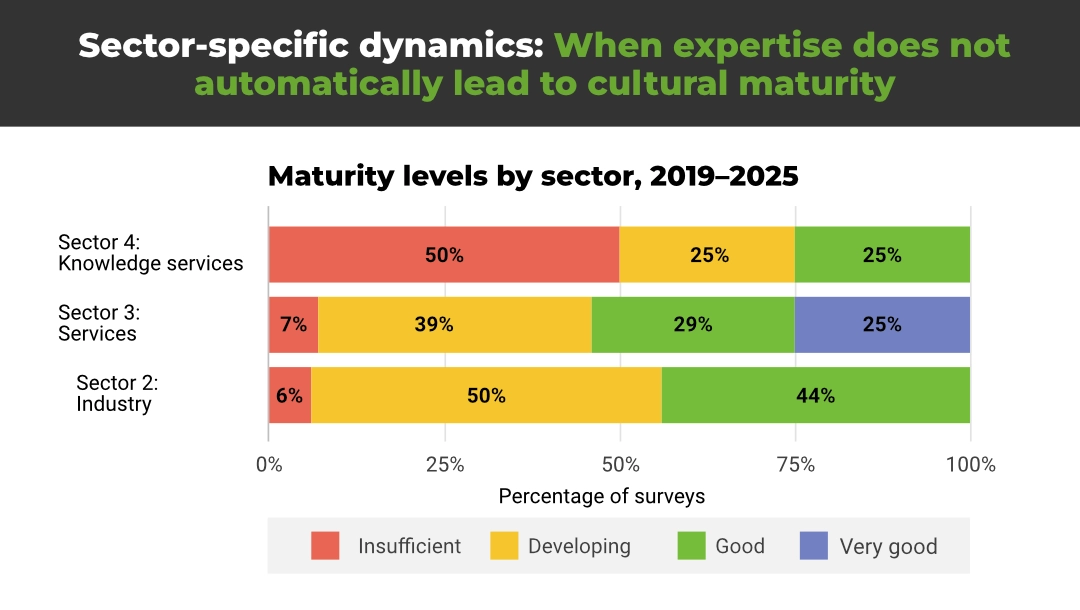
At first glance, these figures seem counterintuitive. One would expect knowledge-intensive industries—with their high level of education and affinity for technology—to score particularly well in terms of safety culture. The opposite is true.
The in-depth domain analysis explains the paradox. In the knowledge-intensive sector, scores in the “Knowledge” domain stand at 67 points (out of a possible 100)—which is lower than in the service sector (75 points) and slightly lower than in the industrial sector (70 points). The differences are even more pronounced in the cultural domains:
The explanation lies in the organizational logic: Knowledge-intensive expert organizations are often person- or task-oriented, with individual autonomy and expert status dominating. In such structures, central control signals have less impact. Security is viewed as the responsibility of informed individuals, not as a shared responsibility.
Another relevant benchmark: Multinational organizations more frequently achieve very high maturity levels than those operating solely within a single country (25% vs. 8%). However, this advantage is not due to geography or size—it stems from the logic of the system. Multinational organizations benefit from:
For smaller and domestically focused organizations, this means: The crucial question is not “Are we international enough?” but “Do we have the same system logic—binding frameworks, consistent processes, and clear governance structures?”
Benchmarking is a valuable tool for orientation, but it is not an end in itself. The crucial question is not one’s position in the industry ranking, but rather: Which bottleneck most severely limits our own maturity development? Comparing ourselves with similar organizations helps us assess this question more realistically.
The Security Awareness Radar provides exactly this context—not only your own position but also a comparison with industry peers and the identification of critical areas for development. This enables focused, resource-efficient management of the security culture.
You can request the full report on 20 years of SAR and the insights it provides HERE free of charge.

Form, E-mail, Phone
You can fill out a short form or send us an email. We will get back to you within two working days. You can also call us directly. Click on "Contact" and you will receive all the necessary contact details.


